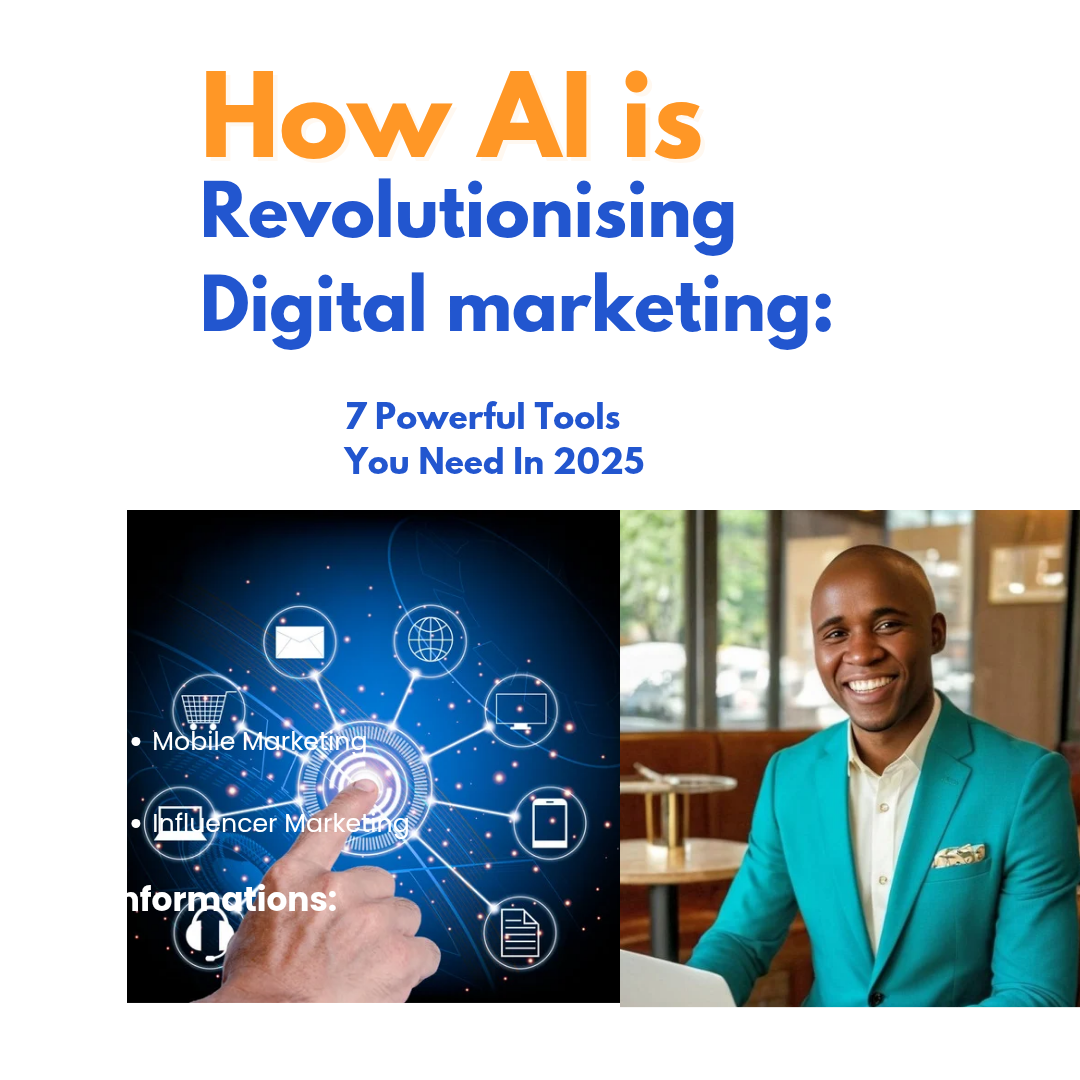
Learn 7 Powerful AI Marketing tools you need in 2025 to automate tasks, create better content, and grow your business faster.
Imagine having a marketing assistant that works 24/7 without rest, analyses customer behaviour in real time, writes captivating copy, designs professional visuals, and predicts your next profitable move. This is not a futuristic dream – it’s the power of AI in marketing today.
Artificial Intelligence (AI) has moved from being a luxury for big corporations to becoming an essential tool for entrepreneurs, marketers, and small businesses globally. Brands that integrate AI now are positioning themselves ahead of competitors in innovation, efficiency, and profitability.
In this ultimate guide, you will discover 7 powerful AI tools every marketer, entrepreneur, and brand strategist must use in 2025 to stay relevant and competitive. Whether you’re building a brand, launching your business, or managing digital campaigns, these tools will transform your productivity and results.
What is AI in Marketing?
Artificial Intelligence (AI) refers to machines simulating human intelligence, including learning, reasoning, and problem-solving. In marketing, AI means using machine learning, natural language processing, and data analytics to automate, optimise, and personalise marketing activities.
Applications in Marketing:
-
Content creation: Generating blogs, captions, videos, and designs quickly.
-
Automation: Scheduling posts, email campaigns, customer replies.
-
Customer insights: Analysing buying behaviour, trends, and feedback.
-
Chatbots: 24/7 customer support on websites and social media.
-
Ad targeting: Identifying ideal audiences for better ROI.
-
Predictive analytics: Forecasting market trends and consumer actions.
Why it matters:
AI empowers businesses to make data-driven decisions, improve customer experience, and operate efficiently, giving brands a competitive advantage in the digital era.
Benefits of AI in Marketing
✅ Automates repetitive tasks: Scheduling, replying, creating variations.
✅ Enhances customer experience: Personalised messages, quick replies, relevant recommendations.
✅ Improves targeting accuracy: AI analyses user behaviour to target the right person with the right message at the right time.
✅ Increases content output efficiently: Generating multiple caption, ad, or blog variations in minutes.
✅ Provides actionable data insights instantly: AI analyses complex data faster than any human team.
✅ Saves time & money: Reduces manual workload, allowing teams to focus on strategy.
Real-life example: Coca-Cola uses AI to analyse social media sentiments and adjust marketing campaigns instantly to align with customer conversations and trends.
7 Powerful AI Tools for Marketers in 2025
🔷 1. ChatGPT (OpenAI)
What it is:
A conversational AI language model by OpenAI that writes, analyses, and communicates like a human.
Uses:
- Generating blog post drafts
- Social media captions and hashtags
- Email sequences and newsletters
- Customer support FAQs
- Business strategy outlines
Example:
Writing a 2000-word blog article outline in under 2 minutes.
Pro Tip:
Always edit AI outputs to align with your brand voice, cultural relevance, and emotional tone.
🔷 2. Jasper AI
What it is:
An AI copywriting tool specialised in creating high-converting marketing content.
Uses:
- Sales page copy
- Facebook & Google ads
- Email campaigns
- Product descriptions
Example:
Generating 10 different headlines for a Facebook ad to split-test the most effective one.
Why it stands out:
Jasper has pre-built marketing frameworks and tone options that boost conversion-focused copywriting.
🔷 3. Canva Magic Write & AI Design Tools
What it is:
AI-powered writing and design features integrated within Canva for creating visuals and text content.
Uses:
- Generating captions and headlines
- Creating branded visuals, logos, presentations, ebooks
- Text-to-image AI generation for unique graphics
Example:
Designing an ebook cover, social media carousel, and promotional post in under 10 minutes using AI suggestions.
Pro Tip:
Combine AI design suggestions with your established brand guidelines for consistency and professionalism.
🔷 4. Copy.ai
What it is:
An AI copywriting tool focused on short-form content creation.
Uses:
- Social media captions
- Product and service descriptions
- Meta descriptions for SEO
- Catchy headlines
Example:
Generating 30 Instagram captions for your next month’s content calendar in minutes.
🔷 5. Surfer SEO
What it is:
An AI-powered SEO tool that helps optimise your blog posts and web pages for higher rankings.
Uses:
- Keyword optimisation
- Content scoring against competitors
- SERP analysis and guidelines
Example:
Improving blog post ranking by ensuring it meets top-ranking competitor keyword density, headings, and structure.
🔷 6. Pictory AI
What it is:
An AI video creation platform that transforms text into videos.
Uses:
- Converting blog posts into YouTube videos
- Creating explainer videos
- Generating social media video content for reels and shorts
Example:
Turning a 1000-word blog post into a professional video summarising key points with visuals and voiceovers in under an hour.
🔷 7. ManyChat AI
What it is:
An AI chatbot platform for WhatsApp, Facebook Messenger, and Instagram.
Uses:
- Automating customer support conversations
- Collecting leads via Messenger
- Running interactive marketing campaigns
Example:
Setting up an automated Messenger flow that collects customer emails and sends them a free ebook instantly.
How to Integrate AI Tools in Your Marketing Strategy
-
Identify repetitive tasks in your marketing process (content creation, scheduling, replies).
-
Start with one tool to integrate smoothly without overwhelming your team.
-
Train your team or yourself to use the tool efficiently.
-
Maintain human creativity: Use AI as an assistant, not a replacement. Personal stories and authentic engagement remain irreplaceable.
-
Track results: Measure improvements in productivity, engagement, and ROI to refine your AI usage.
Challenges and Ethical Considerations
While AI brings massive benefits, marketers must be aware of:
-
Data privacy concerns: Ensure compliance with data protection laws when using customer data.
-
Accuracy and authenticity: Always fact-check AI outputs for relevance, cultural appropriateness, and correctness.
-
Overdependence: Avoid relying entirely on AI; human creativity and emotional intelligence remain essential.
-
Job fears: AI enhances roles by removing repetitive tasks, allowing people to focus on strategy, creativity, and relationship-building.
The Future of AI in Marketing
The future promises hyper-personalised customer journeys, AI-generated video avatars for brand content, and real-time ad creative generation. Businesses that adopt AI today will not just survive but thrive competitively in tomorrow’s digital landscape.
Conclusion
AI is revolutionising digital marketing. From writing captivating copy to automating customer conversations, these tools provide an unmatched competitive edge. Start today by exploring at least one AI tool from this list to transform your business productivity and growth.
Ready to leverage AI for your business?
👉 Contact me via WhatsApp [+260964954938] for a personalised strategy session, or
👉 Join my AI in Marketing Masterclass to integrate these tools seamlessly into your daily operations.